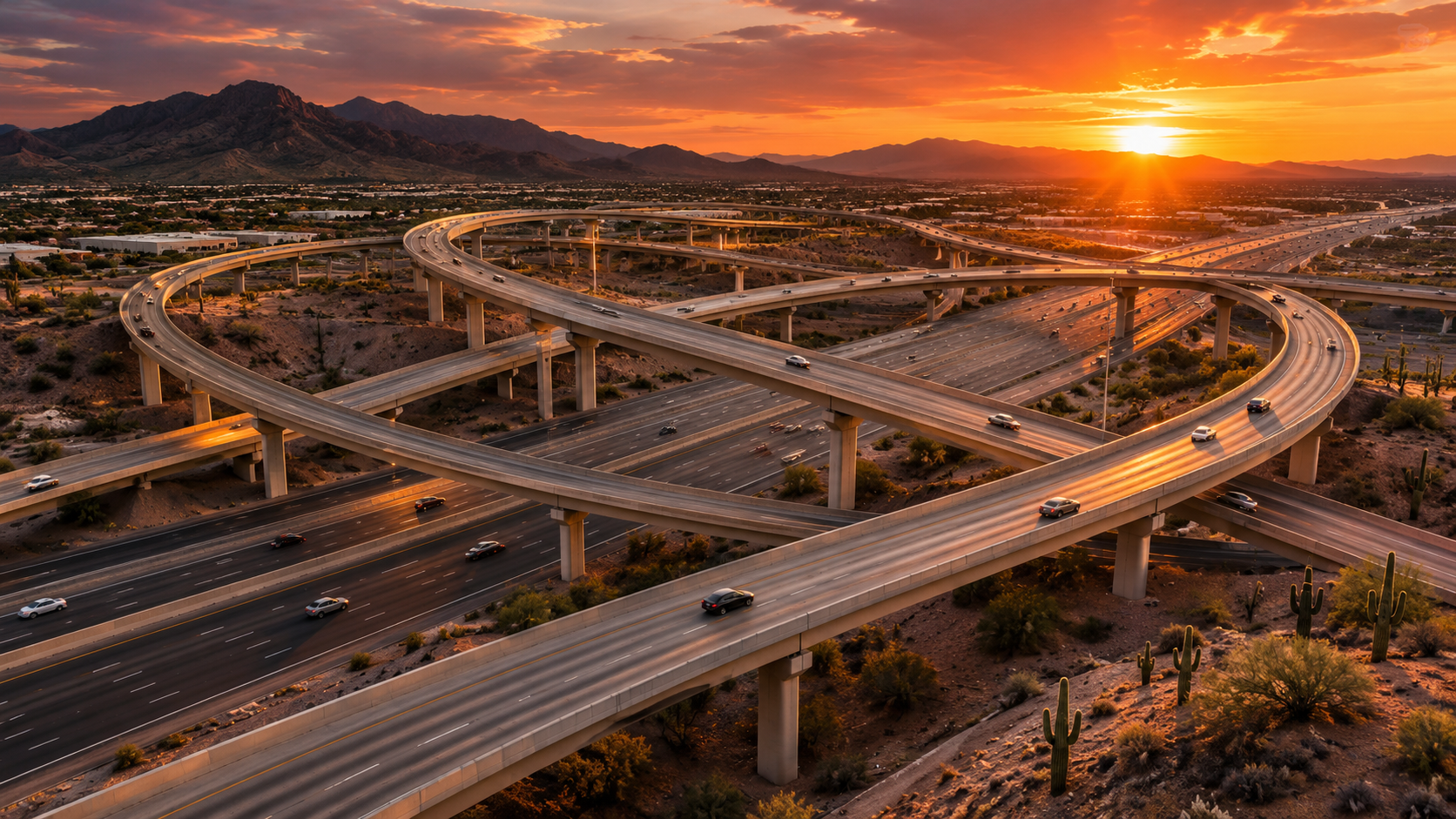
A highway interchange connects traffic moving in different directions. Its ramps, bridges, and lane choices reflect the challenge of moving those streams through a limited space.
More than two roads crossing
From a distance, an interchange can resemble a knot of bridges and ramps. At ground level, each branch serves a particular movement: leaving one road, joining another, or continuing through. The overall structure is easier to understand when those movements are considered separately.
Imagine sketching the turns people need to make between two busy highways. Giving each movement its own path quickly introduces more lines than a simple cross on a map suggests. The illustration explains why an interchange can look elaborate without telling us which design is right for a specific location.
Merging and weaving need space
FHWA identifies interchange geometry, merging, weaving, and heavy traffic volumes as potential contributors to bottlenecks. Where interchanges sit close together, queues at one can affect the next. The connection between roads therefore matters beyond the footprint of an individual ramp.
Weaving refers to crossing traffic movements, such as vehicles entering while others position themselves to leave. From a driver's perspective, this can feel like many decisions arriving at once. From a network perspective, it is a question of how different movements share limited space.
The map hides the experience below
A navigation map is useful for understanding which road to join, but its simplified picture cannot reproduce every sign, lane division, or sightline. A sweeping curve on screen may pass under a bridge, rise above another roadway, or approach a closely spaced choice of exits.
Before an unfamiliar journey, review the route number, direction, and exit you need. These details are often more useful to remember than the artistic shape of the interchange. Set up navigation before departure so it can support the route rather than becoming another task to arrange while moving.
A missed turn does not need a dramatic correction
Allow a journey to include the possibility of taking a different route. If you miss the intended exit, continue legally and let the route be reconsidered from a suitable place. Keeping the itinerary flexible makes a navigation error easier to treat as a delay rather than a crisis.
Interchanges are a reminder that a road belongs to a larger system. What looks complicated overhead is an attempt to connect many individual journeys. For the person driving through, the useful goal is simpler: recognize the needed direction, follow the signs, and give each decision enough attention.
Sources & resources
Technical and safety references checked November 18, 2026. These general guides do not replace instructions for a specific vehicle or road.